
Compare ASTM A333 Grade 6 and A106 carbon steel pipe to choose the right pipe for low-temperature versus ambient pressure service, and learn the impact test and grade details to specify.
A106 and A333 Grade 6 are both seamless carbon steel pipes, and on a mill test certificate their chemistries look almost identical, which is why they are so easily confused. The real difference is toughness at low temperature: A106 is rated for ambient and elevated-temperature pressure service, while A333 Grade 6 is qualified by impact testing for sub-zero service. Using A106 where A333 is required is a serious safety risk in cold service, while over-specifying A333 for routine work adds avoidable cost and lead time. This guide explains how to choose correctly.

Why the Grades Look Similar But Are Not
A106 Grade B is the standard seamless carbon steel pipe for ambient and higher-temperature pressure service, with chemistry and strength set by ASTM A106. A333 Grade 6 covers seamless and welded carbon steel pipe for low-temperature service, with chemistry very close to A106 but additionally qualified by Charpy impact testing at a defined low temperature. The impact test is the essential feature: it proves the steel will not become brittle and crack in cold service, which is exactly what A106 is not guaranteed to do.
When A333 Grade 6 Is the Right Choice
For service at or below minus 45 degrees Celsius, such as refrigeration and cryogenic lines, cold gas piping, low-temperature process lines, and outdoor piping in cold climates, A333 Grade 6 is the correct specification. Its impact-tested toughness prevents the brittle fracture that ordinary A106 could suffer at low temperature. For any welded assembly that will operate in the cold, the impact qualification must cover both the pipe and the welding procedure, since a tough pipe with a brittle weld is still a failure risk.
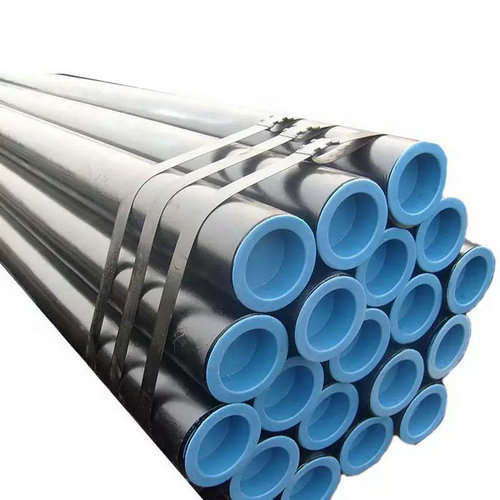
When A106 Is the Right Choice
For ambient and elevated-temperature pressure service, including steam, hot water, process lines, and general fluid transport, A106 Grade B is the standard and economical choice. It is widely stocked in a broad range of schedules and sizes, with shorter lead times than A333, and its chemistry and strength are well suited to its rated temperature range. Specifying A333 in these duties simply adds cost and constrains supply without any benefit, since the low-temperature qualification is irrelevant.
What to Specify on the RFQ
Name the standard and grade explicitly, ASTM A106 Grade B or ASTM A333 Grade 6, and never accept a quote that names only carbon steel pipe or seamless pipe. For A333, specify the impact test temperature and the required impact energy, and request the impact test results on the mill test certificate, since this is the defining feature of the grade. Specify the schedule, size, and end type, and for low-temperature welded assemblies note the welding procedure qualification requirement. Confirming standard, grade, and impact test in one line is the simplest way to prevent the dangerous substitution of A106 for A333 in cold service.