
Packaging is often treated as an afterthought in steel trade, but it strongly affects damage risk, loading efficiency, and warehouse handling. Carbon steel pipe can be packed in different ways depending on diameter, wall, end condition, shipment route, and customer receiving needs. Hex bundles, wooden dunnage, end caps, steel straps, separators, and wrapping all play different roles. The right packaging is not the heaviest possible method. It is the method that protects the pipe effectively without making freight or handling unnecessarily difficult.
Why Packaging Choice Matters Commercially
Packaging affects more than product protection. It influences bundle count, forklift handling, stacking stability, and how the receiving team identifies the material. A package that saves a little on origin cost but increases unloading damage or sorting confusion is not really economical. Buyers working with the carbon steel pipe product range should think of packaging as part of the delivered service level, not just part of the shipping department's job.
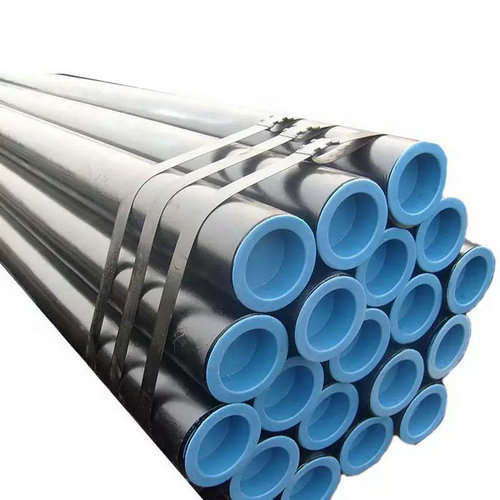
Hex bundles work well for many small and medium pipe sizes because they create stable grouped units. Wooden dunnage helps reduce metal-to-metal damage and improves lifting support. End caps protect prepared ends. Steel straps hold the unit together, but they should not be the only protection measure where the route is demanding.

How Buyers Should Choose a Packing Method
Start with the product itself. Small-diameter bundles may suit hex packing well, while larger welded pipe often needs a different support method. Then think about the route: container shipment, breakbulk handling, long inland transport, and outdoor storage all place different demands on the package. If the order includes prepared ends or sensitive coating, those features should drive the protection method. If the pipe will be redistributed after import, bundle tags and separation become just as important as the straps.
Packaging choice is especially important when the cargo includes mixed sizes or mixed finishes. One generic method rarely protects every line item equally well. Buyers should be ready to assign different packaging rules by size group if necessary.
A Useful Packaging Review List
- Check whether the bundle shape suits the pipe size and route.
- Use dunnage where contact damage or lifting pressure is a risk.
- Match end caps and protectors to the actual pipe end condition.
- Confirm straps, tags, and separators are sufficient for handling and identification.
- Review packaging photos before shipment, not after claim.
Packaging should also reflect how the cargo will be unloaded at destination. A bundle that works well for one forklift-based warehouse may be awkward or damage-prone at another site using slings, cranes, or manual separation. Buyers who match the package to the receiving equipment usually reduce both damage risk and unloading time.
For heavier export cargo, it is useful to compare the packing approach with real bundle forms such as seamless carbon steel pipe export bundles before finalizing the shipment method.
This review helps buyers avoid both overpacking and underpacking. It also gives suppliers a clearer packing scope, which makes quotations more honest and final delivery more predictable.
The Right Package Supports the Whole Supply Chain
Baobin Steel can support buyers with packing suggestions based on pipe type, route, and downstream handling needs, which is especially useful for export buyers who want fewer transport claims and faster warehouse receiving. Packaging is one of the simplest places to improve delivery quality without changing the steel itself.
Hex bundles, dunnage, end caps, and steel straps each have a role. Buyers who combine them intentionally get safer shipments, cleaner receiving, and better overall value from the order.
Packaging should also reflect how the cargo will be unloaded at destination. A bundle that works well for one forklift-based warehouse may be awkward or damage-prone at another site using slings, cranes, or manual separation. Buyers who match the package to the receiving equipment usually reduce both damage risk and unloading time.
For heavier export cargo, it is useful to compare the packing approach with real bundle forms such as seamless carbon steel pipe export bundles before finalizing the shipment method.