
Compare ERW, SSAW and LSAW welded steel pipe to choose the right welded pipe for large-diameter water, oil and gas and piling service, and learn what to specify when ordering.
ERW, SSAW, and LSAW are the three main families of welded steel pipe, and although all are made by welding, they differ in how the seam is formed and therefore in size range, weld shape, and suitable service. Choosing the wrong type can mean a pipe that is uneconomical at the required diameter or unsuitable for the pressure class. This guide explains how to match the welded pipe type to large-diameter water, oil and gas, and structural piling applications.

How the Three Types Differ
ERW, electric resistance welded pipe, is formed from strip and welded by resistance heating without filler metal, producing a straight longitudinal seam and a clean, narrow weld. It is efficient and economical but limited in diameter and wall. LSAW, longitudinally submerged arc welded pipe, is formed from plate with a straight seam welded under flux with filler metal, allowing thick walls and large diameters for high-pressure service. SSAW, spiral submerged arc welded pipe, is formed by winding strip into a spiral and welding the helical seam, enabling very large diameters from narrower strip, though with a longer, spiral weld.
When ERW Is the Right Choice
For medium-diameter water, gas distribution, structural tubing, fencing, and general mechanical service up to roughly 610 millimeters in diameter, ERW is the economical choice. Its clean seam and good dimensional accuracy suit lower and medium pressure applications, and its high production efficiency keeps cost down for the sizes it covers. ERW is the default welded pipe for everyday distribution and structural service within its diameter and wall range.
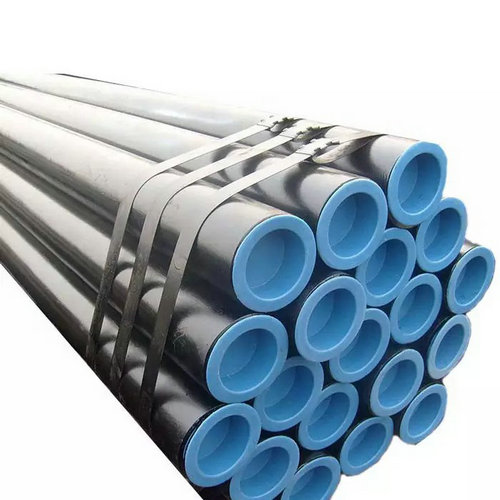
When LSAW and SSAW Are the Right Choices
Above the diameter limit of ERW, the choice is between LSAW and SSAW. LSAW is preferred for high-pressure oil and gas transmission where a straight seam and thick wall are required, since its longitudinal weld from plate supports demanding pressure classes. SSAW is preferred for very large-diameter, lower-pressure service such as water transmission, piling, and structural columns, because its spiral construction can produce very large diameters economically from narrower strip. The trade-off is the longer spiral weld, which makes SSAW less suited to the highest pressure classes where LSAW is stronger.
What to Specify on the RFQ
Name the weld type explicitly, ERW, LSAW, or SSAW, and the applicable standard, such as API 5L for line pipe or ASTM A252 for piling. Specify the diameter, wall thickness, and grade, and for line pipe the pressure class or PSL level. For welded pipe, request the weld seam inspection level, such as ultrasonic testing, and hydrostatic test pressure, since the weld is the critical zone. For SSAW piling, confirm the weld joint and whether end bevels are needed for driving. Stating weld type, standard, dimensions, grade, and inspection level together ensures the right welded pipe is supplied for the service.